Why Does Using AI to Write Feel Like Cheating?
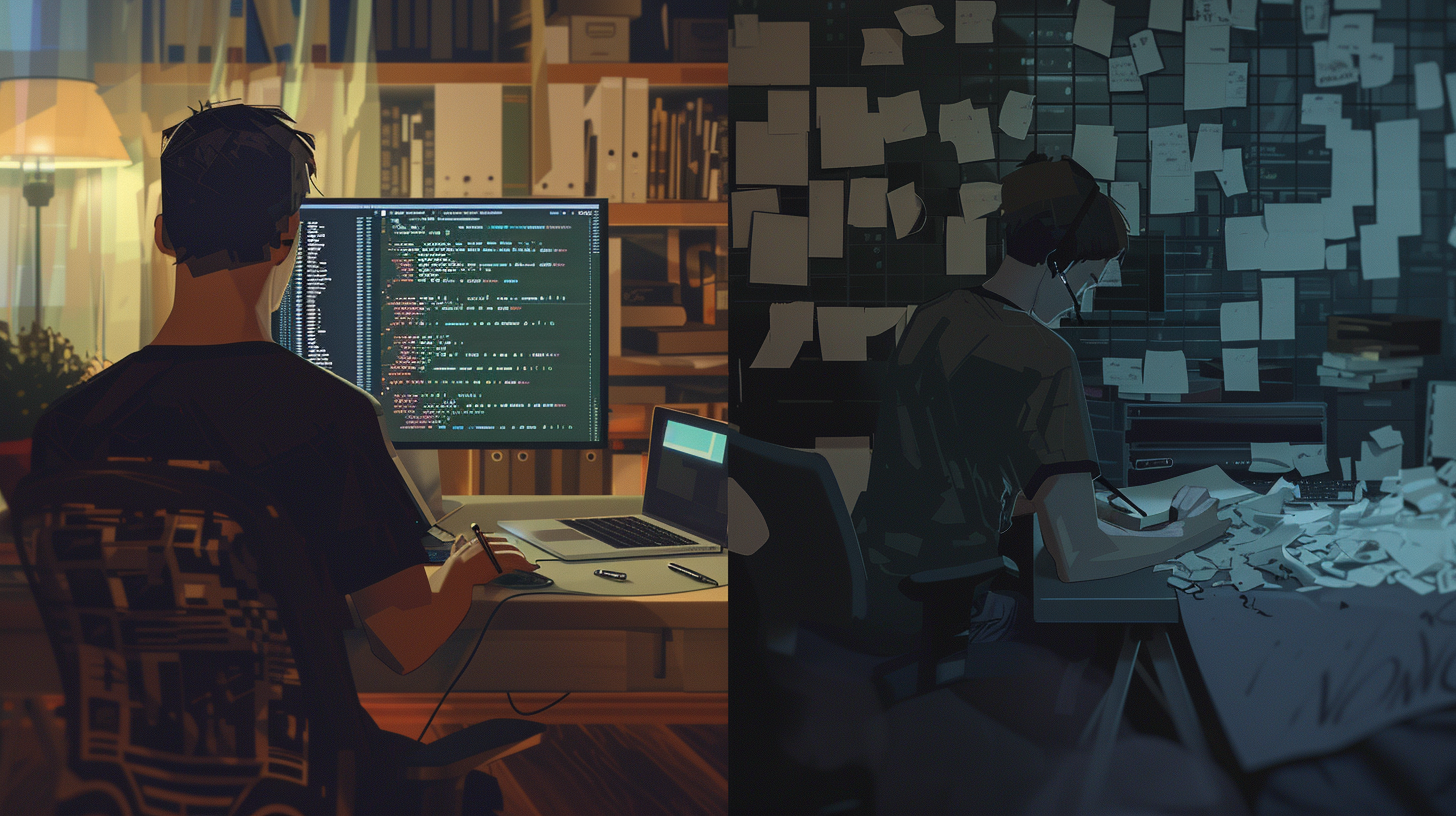
The Double Standard
I use AI to write code every day. Cursor, ChatGPT, Conductor, and Claude Code all help me move faster, sometimes finishing my thoughts mid-keystroke. I don't feel weird about it. Nobody in my field really does. It is just part of how work gets done now.
But for the last few years, every time I thought about using an LLM to help me write a blog post, I felt a small pang of guilt, like the writing would stop being mine.
I had ideas I wanted to get out: opinions about multi-agent architecture, about how teams should think about AI delegation, about patterns I kept seeing in production, social and economic implications of AI. The ideas were there, but the writing was not.
The pace of change in AI kept me busy enough that writing always slipped. And when I did sit down, I couldn't get the words out. So the ideas stayed in my head, half-formed and stacking up.
What Was I Protecting?
I kept coming back to the same question: Why does code feel different?
When AI helps me write a function, I don't feel like the solution stops belonging to me. I already had the architecture in my head. I knew what the function needed to do, what the inputs and outputs were, and basically how it fit into the system. The AI helped me get it onto the screen faster. The judgment was still mine. The implementation just moved quicker.
Writing seems like it should work the same way. I know what I think. I know the argument I want to make, the examples that support it, and the structure that might land. The bottleneck was never the ideas. It was the blank page: getting a first draft out, pushing through the stretch where every sentence feels slightly off.
That is also where LLMs tend to help most. Not by thinking for you, but by giving you something to push against. Something (someone?) to bounce ideas off of. A rough draft to proof. A structure to reorder. It turns writing from pure generation into editing, and editing is where the voice improves.
The Creativity Line
Still, I don't think it is that simple. The discomfort seems to track with how human we think the work is.
Nobody really blinks at AI helping with code. A lot of people are comfortable with AI assisting scientific research, protein folding, drug discovery, and data analysis. Those feel like tool problems. But AI-generated art gets a more visceral reaction. AI music can feel hollow even when people cannot clearly explain why. AI writing sits somewhere in the middle, and the reaction shifts depending on the kind of writing.
There seems to be a line somewhere, and I think it tends to sit near whatever we treat as self-expression. The closer the output gets to something that feels personal, the more the assistance starts to feel intrusive.
A calculator doesn't threaten anyone's identity. Neither did a thesaurus, a spell checker, or a style guide. But this new tool that writes your prose does for many.
I Don't Know Where the Line Is
I can feel that tension in myself, and I don't have a clean answer for it.
The argument I made above, that the ideas are mine and the AI only helps with execution, feels mostly true for technical writing. I am explaining things I have thought and built and patterns I have seen firsthand. In that context, the LLM feels more like a drafting tool than a ghostwriter.
But would I feel the same way about a personal essay? A poem? I honestly don't know. In those forms, the struggle with language seems tied up with the meaning. The word choice is not just packaging. It is a crucial part of the substance.
Maybe the difference is this: in some kinds of writing, most of the value is in the ideas being communicated. In others, more of the value is in the language itself. Technical blog posts mostly live in the first category. Poetry and prose live much closer to the second. Most writing falls somewhere between those poles, which is why the boundary gets fuzzy.
Or maybe that is just the explanation I am giving myself because it makes my current use of AI feel easier to defend.
Writing vs. Not Writing
What I do know is simpler than all of that: For years, I've had ideas sitting in my head and going nowhere. The real choice was not between AI-assisted writing and some pure ideal of authorship. It was between AI-assisted writing and no writing at all.
For me, right now, that is still a difficult choice, but one I am going to make differently now.
The ideas in my posts are going to be mine. The examples come from my own experience. The opinions are things I have tested in production. An LLM helped me get past the block and organize my thinking faster. I am comfortable with that.
Whether that comfort extends to every kind of writing, I am less certain. Anyone who claims to know exactly where AI stops being a tool and starts becoming something else is probably drawing the line in a place that suits them.
I am drawing my own line in a place that suits me too.